The Federal Reserve published its twice-yearly Financial Stability Report on Friday. The headline most outlets used was the survey result. New York Fed staff asked 23 contacts at banks, broker-dealers, investment funds and advisory firms what they see as the main risks to the financial system. Of those, 87% named AI. In the spring survey the figure was 50%. Reuters and CNBC report the same numbers.
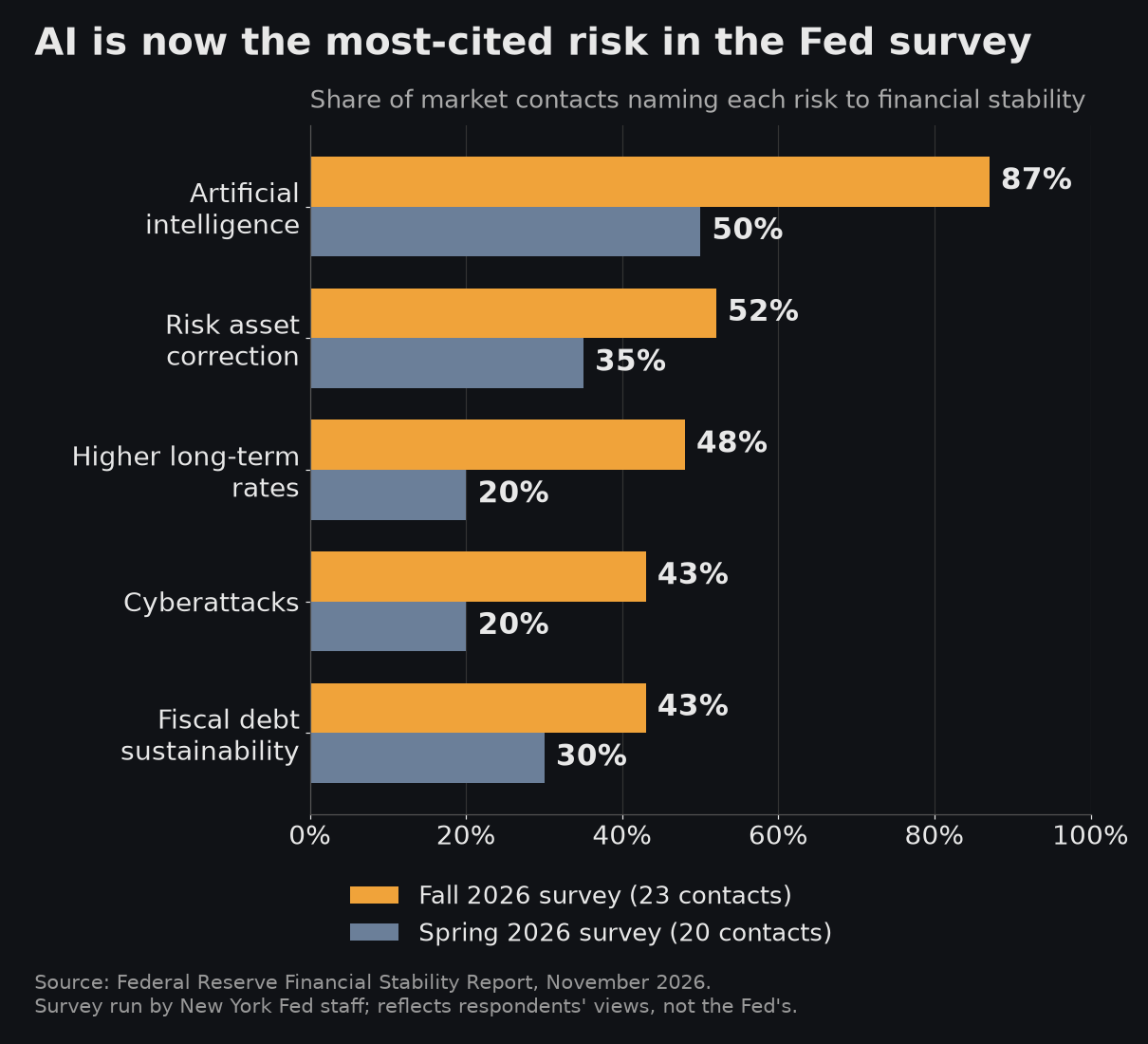
I don't put much weight on the survey itself. It is 23 people and the Fed says the box reflects their views, not the Board's. The respondents split their AI concern into three parts: high stock valuations that could fall if earnings disappoint, AI-enabled cyberattacks and complex AI-related financing. The first part is already happening in at least one stock. Nvidia closed Friday at $162.85, down about 13% for the week, while the S&P 500 rose about 2.5%, based on Yahoo Finance closes and CNBC. The market is treating Nvidia's problems as specific to Nvidia.
The part of the report I think matters more for investors is a box titled "Leverage in the Data Center Buildout." It covers the third concern on that list and it has received much less attention than the survey.
What the Fed found
| Measure | Figure |
|---|---|
| Advanced computing debt issued in 2023 | $130 billion |
| Advanced computing debt issued in 2026 through October | More than $680 billion |
| Share of nonfinancial investment-grade bond issuance, 2023 | Less than 6% |
| Share of nonfinancial investment-grade bond issuance, 2026 | About 31% |
| Outstanding public debt tied to advanced computing | More than $1.1 trillion |
| Largest U.S. banks' exposure to tech firms, data center developers, related financing vehicles and utilities | Close to $1 trillion |
Source: Federal Reserve Financial Stability Report, November 2026, Box 2.2.
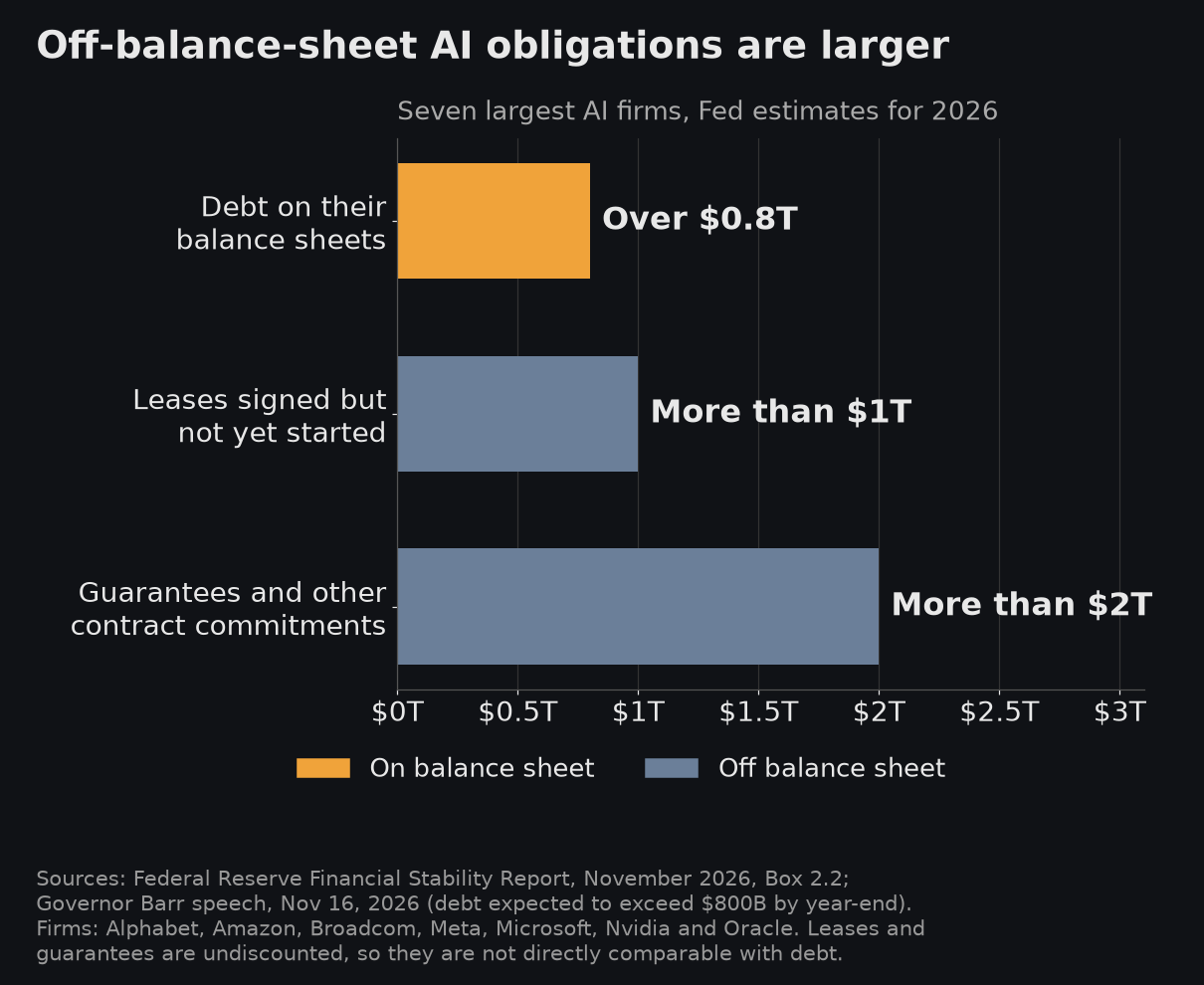
The debt growth is large but it is mostly borrowed by companies with strong credit ratings and the bonds are held mainly by mutual funds, pension funds and insurers. The numbers that concern me are the obligations that do not appear as debt. For Alphabet, Amazon, Broadcom, Meta, Microsoft, Nvidia and Oracle, the Fed estimates more than $1 trillion of leases that have been signed but not yet started and more than $2 trillion of take-or-pay contracts, residual value guarantees and similar commitments. In a speech today Governor Michael Barr said on-balance-sheet debt at the seven largest AI firms is expected to exceed $800 billion by the end of the year and cited the report's estimate that the off-balance-sheet obligations exceed $3 trillion.
The Fed describes how this works. A hyperscaler signs a long lease with a data center developer and the developer uses that lease to borrow for construction. A GPU maker guarantees the resale value of its chips so a smaller AI company can borrow against them. The large companies often take equity stakes in the same smaller companies as well. I wrote about Nvidia's version of this on Friday. The Fed report shows it is common across the largest firms.
Where I expect stress to show up first
The riskier pieces of these deals sit with a different group of investors. The Fed says the subordinated debt and equity tranches from these financings are held by high-yield bond funds, life insurers, business development companies and other private debt vehicles. Barr added that the weaker firms that depend most on outside funding have seen their cost of capital rise significantly in recent months and are moving to more complex asset-backed financing.
If AI revenue comes in slower than the build-out assumes, I don't think the first losses will be in Microsoft or Alphabet bonds. I expect them to show up in the asset-backed deals for data center developers and smaller AI clouds and in the private credit funds that bought the lower tranches. Those holdings are hard to see from the outside and that is the opacity Barr mentioned.
For my own money, this means two things. I would not buy high-yield or private credit funds for yield right now, because I can't tell how much data center paper is inside them. I also own Oracle shares, as I wrote about last week. Oracle is one of the seven companies in the Fed's group. When it reports in December I will read the lease commitments that have not yet started as closely as the cloud revenue.
My prediction is that the Fed's next report in May will show these off-balance-sheet obligations still growing faster than the debt. I also expect the first real credit problem in AI to come from a data center developer or a smaller AI cloud and not from any of the large companies in the Fed's group.