The Bureau of Labor Statistics reported this morning that the Consumer Price Index rose 0.4% in October on a seasonally adjusted basis and that prices excluding food and energy rose 0.3%. Economists polled by Dow Jones had expected 0.3% and 0.2%, according to CNBC. Shortly after the release, Nasdaq-100 futures were down 1.2% and S&P 500 futures were down 0.5%.
That undoes a good part of Monday's mood. The S&P 500 rose 2.35% yesterday for its best day since April 8 and Reuters tied much of the move to falling oil after President Trump played down the chance of new strikes on Iran. WTI crude fell 4.4% to settle at $86.85 a barrel. I understand the relief. Lower oil helps headline inflation and it helps consumers. It does very little for the part of inflation the Fed is most worried about right now.
| Measure | September | October forecast | October actual |
|---|---|---|---|
| All items | 0.6% | 0.3% | 0.4% |
| Less food and energy | 0.3% | 0.2% | 0.3% |
Sources: BLS for actual figures and CNBC for the Dow Jones forecasts.
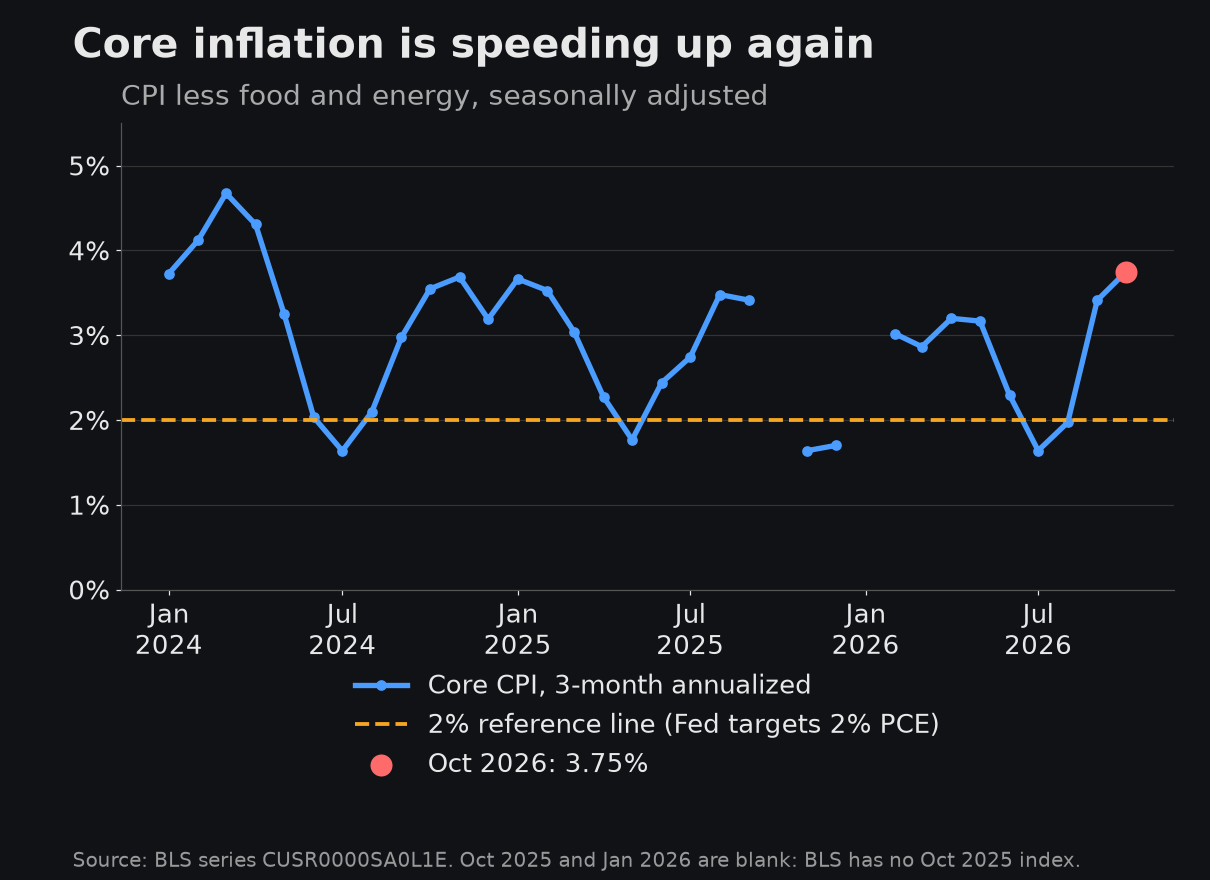
Core inflation over three months
Core CPI has now risen 0.3% in August, September and October. Using the BLS index levels, I calculate that core prices rose at a 3.75% annualized rate over the last three months. That is the fastest three-month pace since April 2024 and it is nearly double the 2% line. The Fed's target is set on the PCE price index rather than CPI, but Reuters noted that both PCE measures are already running above 3%.
The details point the same way. Shelter rose 0.3% and BLS said it accounted for more than 30% of the monthly increase. Recreation rose 0.8%, motor vehicle insurance rose 0.7% and hospital services rose 0.8%. Food away from home rose 0.5%. Cheaper gasoline will not bring those prices down. Energy rose only 0.7% after a 5.2% jump in September, so the headline number beat forecasts with much less help from fuel than it had a month earlier.
BLS did not publish a 12-month rate because it collected no October 2025 data during the government shutdown. If I fill the gap with the average of the September and November 2025 index levels, which is a rough method several economists have used, headline CPI comes out just under 4% and core comes out near 2.8%. Those are my estimates and not official figures.
What I expect from the Fed
The Fed raised its target range to 3.75% to 4% on September 16 and held it there on October 28. In September, 16 of 18 officials projected another hike this year, according to CNBC's summary of the dot plot. Before today's report, CME FedWatch put the odds of a December hike at about 82%, Reuters reported. Governor Christopher Waller said in a speech this morning that if inflation readings came in higher than expected, "a 50 basis point hike in the policy rate should be considered at the December meeting." He added, "Hiking only 25 basis points would put our credibility at risk," CNBC reported.
The readings did come in higher than expected. I now think a December hike is close to certain and I would give a 50 basis point move real odds, especially if Friday's producer price report is also hot. I also no longer expect December to be the last one. October payrolls rose by 165,000, which was more than double forecasts. Core inflation is running near 3.75% annualized. With both of those in hand, I think at least one more hike in the first half of 2027 is more likely than not.
How I am treating the bounce
The 10-year Treasury yield was about 4.89% before the report, per CNBC. For high-multiple tech stocks, that yield and the path of the funds rate will matter more over the next month than the price of oil. Last week's selloff was driven by worries that new regulation after the midterms could slow the AI buildout. This week the pressure is coming from rates, which is a different problem and usually a slower one to clear.
For that reason I am not adding to expensive growth stocks on Monday's rally. I would rather wait for Friday's PPI and the December 9 decision and buy after the Fed shows how far it intends to go. Companies producing cash today should be able to handle a funds rate above 4%. The ones whose valuations depend on profits several years out are the ones I expect to struggle until the Fed signals it is finished. Oil can keep falling for the next four weeks and I still expect the funds rate to be higher on December 10 than it is today.